World Marathon Major · New York, United States
New York City Marathon
The New York City Marathon is the world's largest, run every November through all five boroughs from Staten Island to Central Park. Places come mostly from a lottery, charity partners and tour packages, with a small, very competitive time-qualifier route.
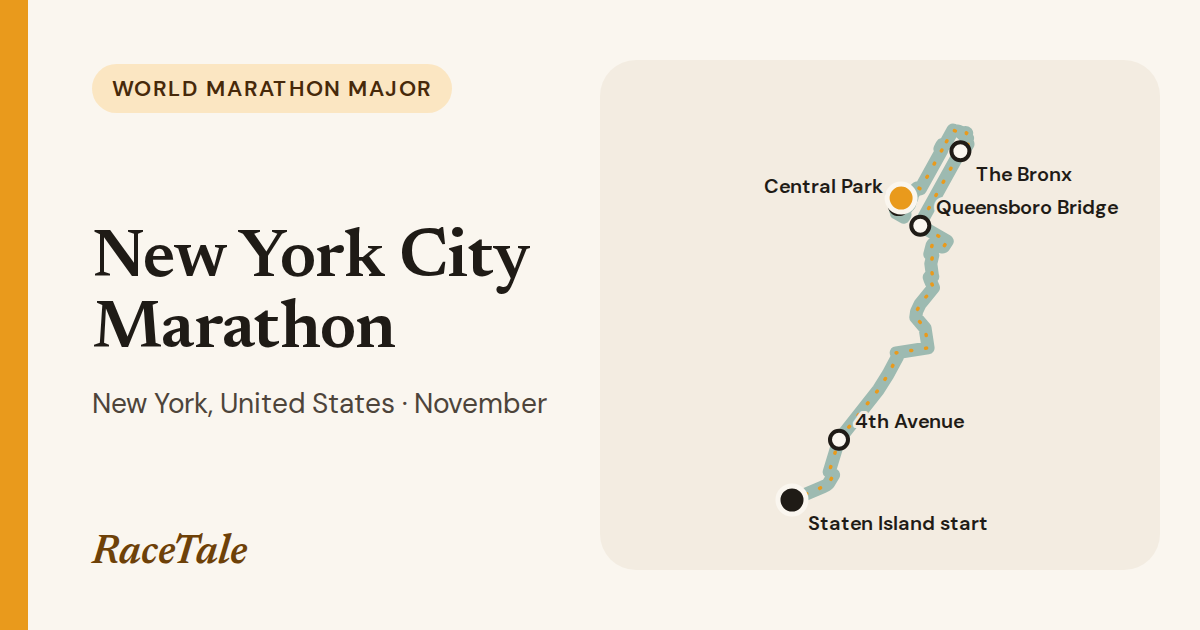
- Where and when
- New York, United States · November
- First run
- 1970
- Field size
- about 55,000 to 61,000
- Average finish
- about 4:08
- How to get in
- Lottery, charity, tour packages, or a time qualifier (or guaranteed through local NYRR races)
- Official site
- nyrr.org/tcsnycmarathon
Dates, fees and rules change every year, so confirm on the official site before you plan.
About the New York City Marathon
Started in 1970, the race is run by New York Road Runners. It is known for its crowds on every avenue, the bridges that join the boroughs and a finish in Central Park. Runners who take part in enough NYRR races can earn guaranteed entry.
Watch the New York City Marathon run again
This is what a RaceTale story does with a race day: it replays the whole course with your time, the route and every photo and cheer your family and friends added from any phone, in one private link.


How do you get a place in the New York City Marathon?
A public random lottery, charity fundraising places, official international tour packages, or time-qualifier places, which are very competitive. Guaranteed entry exists for runners who complete enough local NYRR events.
- When entry opens: The application window usually opens in February for the November race.
- Cost: About $255 USD for US residents and $358 USD for international runners.
What is the New York City Marathon course like, and what is the cut-off?
A tour of all five boroughs, from the Verrazzano-Narrows Bridge to Central Park. It is crowded and tactical: steep bridge climbs (notably the Pulaski and Queensboro bridges) and a long, grinding false flat up Fifth Avenue.
Cut-off: More than 8 hours, with the course officially closing at 10:00 pm. A sweep vehicle follows the final wave at about 16 minutes per mile, and runners it passes can finish on the sidewalk.
Where should spectators watch the New York City Marathon?
- Fourth Avenue, Brooklyn, miles 2 to 4Wide avenues right after the Verrazzano-Narrows Bridge, with bands on every corner and big crowds.
Getting there: The R train to a station on 4th Avenue, such as Bay Ridge-95 St or 36 St. - First Avenue, Manhattan, miles 16 to 18Runners come off the quiet Queensboro Bridge into a wall of noise.
Getting there: The 4, 5 or 6 train to 59 St/Lexington Ave or 86 St, then walk two blocks east to 1st Avenue.
Work out when your runner reaches each spot with the spectator timing planner, set to this race's usual start time. Tracking and signal can fail in a crowd, so agree a meeting place and a time before race day. See how to get around a marathon as a spectator.
What are the weather, start times and tracking like?
- Weather: Crisp and usually favourable, about 7 to 14°C (45 to 57°F). The exposed bridge at the start is often cold and windy.
- Start times: Wheelchairs 8:00, elite women 8:40, elite men 9:05, then five colour-coded mass waves from 9:10 to 11:30 am.
- Tracking: The TCS NYC Marathon app shows live tracking and predicts a runner's position from their pace.
Is the New York City Marathon a good first marathon?
Good, with hill training (ranked 5 of 8 for a first-timer). The most generous time limit of any major and unmatched crowds, but the bridges will test a first-timer who has not trained on hills. See the full ranking of the eight majors.
Frequently asked questions
How do I get into the New York City Marathon?
Through the public lottery, a charity place, an official tour package, or a time qualifier. Runners who complete enough NYRR events can earn guaranteed entry. The application window opens in February.
How hilly is the course?
Moderately, but the hills are bridges. The Verrazzano-Narrows is the biggest climb, and the Queensboro Bridge and the long false flat up Fifth Avenue come when you are tired.
What is the time limit?
Over 8 hours, with the course closing at 10:00 pm. It is the most generous of the majors.
Is it a good first marathon?
It is a wonderful experience and welcoming to slower runners, but the bridges are hard. Train on hills first.
Where do spectators see runners more than once?
Brooklyn's Fourth Avenue early and First Avenue in Manhattan around miles 16 to 18 are reachable by subway. Our spectator planner works out the times.
Plan your race day
- Spectator timing planner: when your runner passes each spot, even from another time zone
- Pace chart: split times for your goal time
- Race time predictor: an estimate from a recent result
- Where to stand to watch a marathon
- How to get around a marathon as a spectator
- How to track a runner on race day